
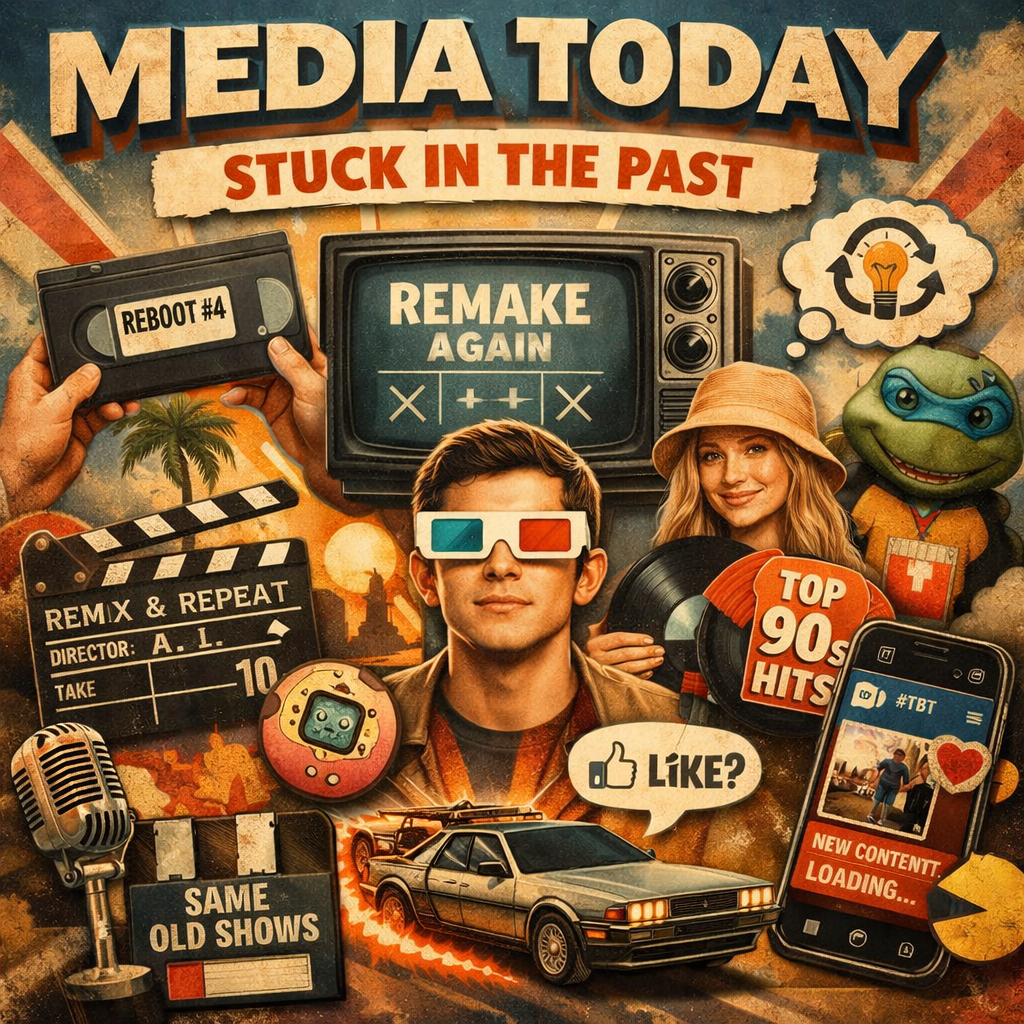
Some people argue that media has become increasingly nostalgic and unoriginal. This type of opinion-based question frequently appears in IELTS Writing Task 2, requiring candidates to evaluate a claim and clearly justify their position. In this IELTS essay on social media, we examine the idea of originality in modern media and explore the extent to which nostalgia dominates current content. You’ll find two sample responses: one written with lower-level vocabulary and simpler structures typical of a Band 5.5 essay, and another upgraded version using advanced grammar, cohesive devices, and academic vocabulary aimed at Band 7 and above. By comparing the two, you can see exactly how ideas are developed, justified, and refined to meet examiner expectations—and how to elevate your own writing.
Task: Some people today argue that media has become increasingly nostalgic and unoriginal. To what extent do you agree or disagree?
Band 5.5–6
In the current world, many people talking about the media and if it is always looking back to the past. The argument is that television shows, movies, and music are not new ideas, but just copies of old things. I mostly agree with this opinion because there is so many old things being used again.
One big reason for me agreeing is that many films are not new. You can see many remakes of old films from twenty or thirty years ago. The producers and companies are scared to make something new because it might not make money. If they make a movie that people know already, they think it is safer. This mean that the quality of films is going down and there is less creative ideas.
Also, music is not so original now. Many songs use parts from very old songs, which is called sampling. It is not wrong but it is not a new idea, it is using a part of a old idea. For young people, it is a new song, but for older people, they hear the past song inside. The result is that media is becoming a copy of itself.
However, some people say that the internet and social media allow for new originality. Small people can make their own creative videos on platforms like YouTube and they are not always copied. This show that some originality still exist, but it is not in the big companies.
To conclude, I largely agree that media is too nostalgic and unoriginal because companies want to make money and not take risks. This makes a lot of old things being reused.
Band 5.5–6 Justification
🧠 1. Task Response – Band 6.5
- ✅ Strength: Clear position is maintained and both sides are addressed.
- ❌ Weakness: Ideas are not deeply developed or explained.
- 💡 Improvement Tip: When making a claim, explain why it matters or what it leads to. Don’t just state facts — show cause, consequence, or implication. Example (unrelated): “Online learning is more flexible. This flexibility allows students in remote areas to pursue higher education without relocating, reducing dropout rates in underserved regions.”
🔗 2. Coherence and Cohesion – Band 6
- ✅ Strength: Clear structure: intro, body, and conclusion are all present.
- ❌ Weakness: Overuse of basic linkers (e.g., “also”, “so”) leads to mechanical flow.
- 💡 Improvement Tip: Learn and use a range of transitional phrases that match different logical relationships (contrast, result, addition, etc.). Example (unrelated): While electric vehicles reduce emissions, their production still relies heavily on fossil fuels. Nevertheless, they represent a significant step toward sustainable transport.
🧰 3. Lexical Resource – Band 5.5
- ✅ Strength: Vocabulary is understandable and appropriate for a general audience.
- ❌ Weakness: Too many basic, repetitive words; lacks topic-specific or idiomatic language.
- 💡 Improvement Tip: Replace vague or repeated terms with precise vocabulary, and experiment with collocations or idioms. Example (unrelated): Basic: People like to use the internet. Improved: Many users are drawn to the internet due to its immediacy and global reach.
📚 4. Grammatical Range and Accuracy – Band 6
- ✅ Strength: Mostly correct simple structures; meaning is clear throughout.
- ❌ Weakness: Limited variety in sentence types; few complex or embedded structures.
- 💡 Improvement Tip: Use a mix of sentence types: conditionals, relative clauses, inversion, and contrast structures. Example (unrelated): “Had the project received more funding, the outcomes might have been different.” “The company, which was founded in 1998, has expanded globally.”
📊 Final Score: Band 6.0
This essay is clear and easy to follow, which is a strong foundation. To reach Band 7, one needs to:
- Develop ideas more fully with specific, relevant examples
- Broaden vocabulary and start using topic-related and precise expressions
- Use more complex grammatical structures with control and variety
- Improve cohesion by using a greater variety of linking devices and avoiding repetition
With targeted improvement, especially in vocabulary and development of ideas, Band 7 is within reach.
Band 7–7.5
Task: Some people today argue that media has become increasingly nostalgic and unoriginal. To what extent do you agree or disagree?
In recent years, it has been argued that the media has become more nostalgic and lacks originality. I partly agree with this view, as many mainstream media products rely heavily on past ideas. However, I believe that originality still exists, especially outside traditional media industries.
On the one hand, it is clear that nostalgia plays a significant role in today’s media. Many popular films and television series are remakes, sequels, or adaptations of earlier works. Media companies often prefer these familiar formats because they reduce financial risk and attract audiences who already feel connected to the characters or stories. As a result, viewers may feel that new releases offer little surprise and repeat the same themes, which supports the idea that media has become unoriginal.
On the other hand, it would be inaccurate to say that creativity has disappeared entirely. New forms of media, particularly online platforms, have created opportunities for fresh content. Independent creators are able to experiment with storytelling, formats, and topics that are rarely seen in mainstream productions. In addition, podcasts and documentaries frequently explore modern social issues in innovative ways, which shows that originality is still present, even if it is less visible.
In conclusion, while nostalgia is increasingly common in large-scale media and popular entertainment, this does not mean that all media is unoriginal. I agree to some extent with the statement, but I believe that originality has shifted rather than disappeared, and it can still be found by audiences who look beyond mainstream media.
Justification: Band 7–7.5
🧠 Task Response – Band 7
- ✅ Strength: The position is clear throughout, and the writer addresses both parts of the prompt (nostalgia + originality), giving a balanced view.
- ❌ Weakness: Some supporting ideas are overgeneralized (e.g., “media companies prefer familiar formats”), and examples lack detail or depth.
- 💡 Suggestion: Support your points with more specific examples or explanations. Instead of simply referring to “media companies,” describe how or why they rely on past content. Unrelated example: Instead of saying “Many people exercise to be healthy,” add specificity: Many office workers begin exercise routines to combat the negative effects of sedentary jobs, such as back pain and low energy.
🔗 Coherence and Cohesion – Band 7
- ✅ Strength: The essay has clear paragraphing and a logical progression of ideas. Topic sentences are well-controlled and transitions are smooth.
- ❌ Weakness: Cohesive devices are somewhat repetitive and mostly basic (e.g., “On the one hand”, “On the other hand”, “In conclusion”).
- 💡 Suggestion: Integrate a greater variety of cohesive expressions and use finer-grained linkers to show contrast or result more naturally. Unrelated example: Instead of always saying “However,” try: “Despite this,” “Nevertheless,” or “That being said.”
🧰 Lexical Resource – Band 7
- ✅ Strength: Vocabulary is appropriate, generally accurate, and somewhat varied (e.g., “adaptations,” “mainstream productions,” “innovative”).
- ❌ Weakness: The word choices are safe and could be more precise or sophisticated in places. Idiomatic expressions or topic-specific lexis are missing.
- 💡 Suggestion: Introduce less common expressions or collocations relevant to the topic to raise lexical variety. Unrelated example: Instead of “People spend more money,” try: Consumer spending has surged, particularly in the tech sector.
📚 Grammatical Range and Accuracy – Band 7
- ✅ Strength: The essay uses a mix of simple and complex sentence forms with generally good control of grammar and punctuation.
- ❌ Weakness: Complex structures are used cautiously and lack flexibility; there’s minimal risk-taking with grammar.
- 💡 Suggestion: Vary sentence structures more deliberately — try inversion, conditionals, or concessive clauses to add range. Unrelated example: Instead of “People work hard to succeed,” try: “Were people given more support, they might achieve success more easily.”
📊 Final Band 7–7.5 Justification
This essay shows all the positive features of Band 6 and most of Band 7, particularly in clarity, structure, and consistency. To push confidently into Band 7.5, the writer needs to enhance lexical variety and expand grammatical range without losing control.
✨ Lift Your Score with Transitions
Did you notice how that Band 7–7.5 essay used transitions to create flow? There’s more to transitions than meets the eye, and mastering them could be what lifts your score.
🚀 Submit your essay for prompt, targeted feedback and personalized links to writing tools that build the clarity, structure, and cohesion needed for a Band 7.5+.
Let’s turn your writing into the next success story.